World & story
The Four Ages of The Adventures of Elliot
The Doorway of Time sends Elliot and Faie a thousand years into the past, and the whole adventure is structured around four ages — four distinct eras you travel backward through, each with its own town, cast and dangers. Here is what we know about every era.
Advertisement
The Doorway of Time and the four ages
ConfirmedOne artifact, a thousand years of history, four playable eras travelled in reverse.
The continent of Philabieldia has been overrun by beast tribes for as long as anyone can remember, and humanity now clings to a single corner of the map. When Elliot and his fairy companion Faie uncover a relic called the Doorway of Time deep in the Doorway Ruins, they gain the power to step across the centuries — a journey that 'transcends space and time' in order to lift the curse afflicting Princess Heuria.
The story is explicitly framed as 'Four Ages across a Thousand Years.' Rather than marching forward, Elliot travels backward through history: from his own present, into a ruined dark age, back to a glittering golden age of magic, and finally to the very dawn of human civilization. Each of the four ages is a self-contained chapter with its own settlement, supporting characters and threats — yet what you do in one era can echo into the others, which is exactly why previewers keep reaching for the Chrono Trigger comparison.
- Travel method
- The Doorway of Time, found in the Doorway Ruins
- Span
- Roughly a thousand years of history
- Direction
- Backward — present to the birth of civilization
- Goal
- Lift the curse on Princess Heuria of Huther
| Era | Nickname | When | Hub |
|---|---|---|---|
| Age of Safekeeping | The Present | Elliot's home era | Kingdom of Huther |
| Age of Reconstruction | The Dark Ages | ~250 years back | Littlehope |
| Age of Magic | A Golden Age | Humanity's zenith | Weyzn |
| Age of Budding | Birth of Civilization | Furthest back | Hitoyori |
Age of Safekeeping — the present
ConfirmedElliot's home era, where humanity survives behind a magical barrier.
The first of the four ages is the Age of Safekeeping, Elliot's own present day. Humanity's last bastion is the Kingdom of Huther, which stands in one corner of Philabieldia and is kept safe from the beast tribes by a magical barrier known as the spell of Safekeeping. That barrier is sustained by Princess Heuria, who spends her days bound to her prayer room, praying for the land's safety even as she longs to see the world outside the walls.
Because the kingdom is walled off and comparatively stable, this era functions as the adventure's home base and tutorial ground — the place you return to between expeditions and where the newly discovered ruins first appear. The court that surrounds Elliot here sets the tone for the whole journey: a benevolent throne, an ambitious minister, and a scholar who points the young adventurer toward the past.
- Hub
- Kingdom of Huther (humanity's last bastion)
- Protection
- Heuria's spell of Safekeeping (the barrier)
- Role in the story
- Starting era and home base
King Hichard
Benevolent ruler of Huther
A kindly monarch whose guiding maxim warns against being ruled by one's own authority. (Gematsu inconsistently renders the name 'Ichard' in places; 'Hichard' is the standard spelling.)
Kaifried
The king's shrewd minister
A sharp political mind who is also a capable swordsman. He favors actively seeking out new magic to strengthen the kingdom rather than relying solely on the barrier.
Euygene
Royal scholar, former adventurer
Once an adventurer himself, the kingdom's scholar recommends that Elliot explore the newly discovered ruins beyond Huther's walls — the very expedition that uncovers the Doorway of Time.
Age of Reconstruction — the dark ages
ConfirmedRoughly 250 years back, with no barrier and humanity on the brink.
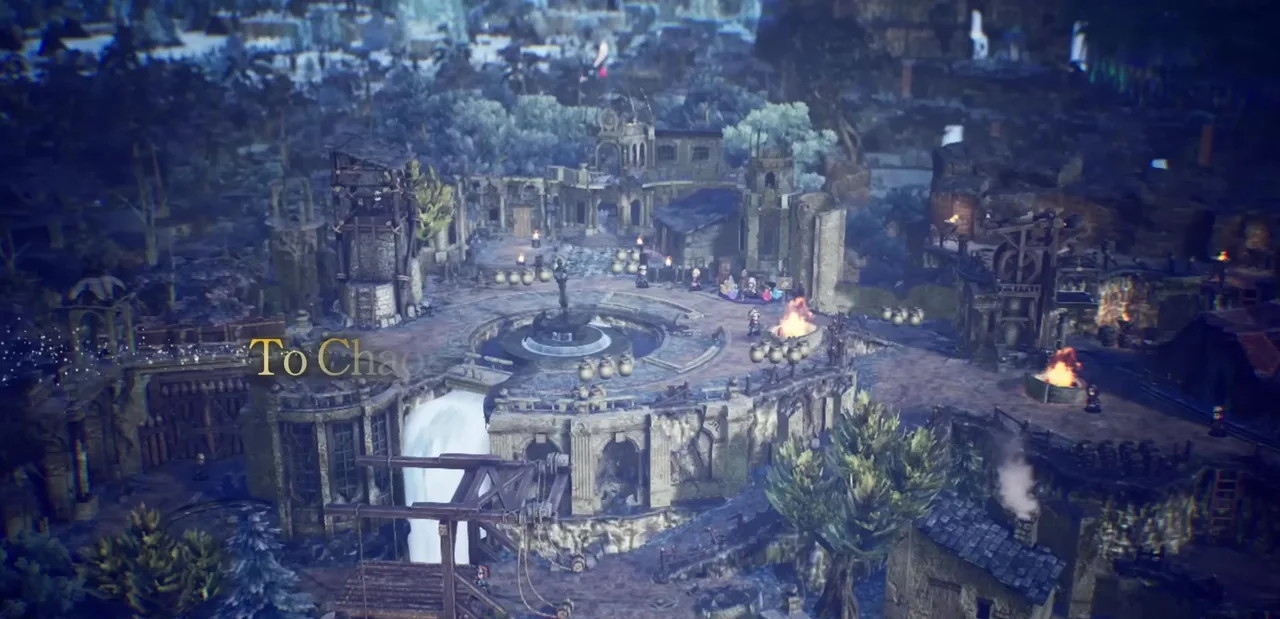
Step through the Doorway and roughly 250 years fall away. The Age of Reconstruction is the dark ages of Philabieldia: there is no spell of Safekeeping in this era to repel the beastmen, and the scattered remnants of humanity live on the brink of extinction amid the ruins of a more prosperous time. Survivors huddle together in the village of Littlehope, scraping by on meager resources. Most villagers have given in to despair — but a single young man still looks to the future, and his optimism becomes a thread Elliot can pull on.
Mechanically, this is also where two of the game's exploration systems come to the fore. Faie can activate the Shrines of Life scattered through the era, and clearing them raises Elliot's maximum health — the closest thing the game has to a 'level up' in a world with no traditional leveling. The era's signature setpiece is a boss fight against the Tag Guardians, a paired encounter against a Greatsword Guardian and a Great Bow Guardian that must be handled together.
- Hub
- Littlehope (a struggling village)
- When
- The dark ages, ~250 years before the present
- Protection
- None — no spell of Safekeeping
- Signature boss
- The Tag Guardians (Greatsword + Great Bow)
Heurich
Adventurer of Littlehope
A kindred spirit who befriends Elliot and shares intel on ruins and treasure. He roams the continent searching for a cure for his childhood friend Diona's illness, hoping to drag the world out of its dark age.
Diona
Heurich's childhood friend
Caring and warm, she grew up alongside Heurich but a chronic illness keeps her indoors. She frets constantly over his reckless adventuring.
Calotesia
Littlehope's historian
The village's resident historian and a mutual friend of Heurich and Diona. She takes a keen interest in how closely Elliot resembles Heurich.
Age of Magic — a golden age
ConfirmedHumanity at its zenith, sustained entirely by magic — and divided over how to use it.
Travel further back and the ruins of the dark ages resolve into the gleaming towers that built them. The Age of Magic is a golden age, humanity at its height, with magical advances powerful enough to drive the beast tribes back. At its center is Weyzn, a nation of magic lined with magnificent buildings whose citizens depend on magic for nearly every part of daily life. There is dramatic irony baked into the visit: you already know this brilliant era eventually collapses into the dark age you just left.
Weyzn's prosperity rests on two rival research institutions, and the tension between them frames the era's story. The Forthewor Institute pursues magical and technological advancement by any means — progress at any cost — while the Formanit Institute is dedicated to using magic to improve and enrich ordinary people's lives. Their research relies on thaumata, magical organisms used in field tests, and the question of how far that research should go drives a quiet conflict among the era's cast.
- Hub
- Weyzn (a nation of magic)
- Era
- A golden age — humanity's zenith
- Rival institutes
- Forthewor (progress at any cost) vs Formanit (magic for people)
- Test organisms
- Thaumata
Fausta
Founder of the Formanit Institute
She broke away from Forthewor to found Formanit, devoted to magic that improves people's lives. Rigorous and highly trusted, she is the institute's guiding director.
Marnie
Formanit researcher
A young researcher who field-tests thaumata and works on magical and mechanical engineering. She idolizes Director Fausta.
Hildebrandt
Director of the Forthewor Institute
Appointed director at a young age and esteemed throughout Weyzn, he is a pragmatist who prizes results above all — the human face of 'progress at any cost.'
Ikarus
Head of Weyzn's nobility
A stern noble who heads Weyzn's aristocracy. Worried about how far Forthewor will push, he allies with Fausta and seeks her counsel.
Age of Budding — the birth of civilization
ConfirmedThe furthest point back: the dawn of humanity, and the mysterious Myū tribe.
The last and furthest of the four ages is the Age of Budding, the birth of civilization itself. At this dawn, humans have only just begun fashioning their own weapons to hold the beast tribes at bay in a precarious balance. Square Enix calls it 'the greatest turning point in the history of Philabieldia,' and your hub here is Hitoyori, described as the earliest human settlement — the seed from which everything Elliot has already witnessed eventually grows.
What makes this era pivotal is the Myū tribe: a people distinct from the beasts who can speak the human language and wield powerful magic. The story deliberately leaves their meaning open — does their power represent a new hope for humanity, or a new threat? That unresolved question sits at the heart of the era, and the three characters below each answer it differently, turning Budding into a debate about fear, trust and the future of magic.
- Hub
- Hitoyori (the earliest human settlement)
- When
- Birth of civilization — furthest back in time
- The Myū
- A tribe that speaks human language and uses powerful magic
Kai
Young chief of Hitoyori
Fixated on the beast threat, the young chief regards the Myū as no different from the beasts and their magic as dangerous. He vows to protect the village at all costs.
Hirk
Hitoyori magic student
She has studied magic for years without putting it to practical use. She sees magic as Hitoyori's future and wants to befriend the Myū to learn from them.
Lyudmila
A Myū of the snow fields
A Myū woman living in a snow field away from Hitoyori. Through the story's events she ends up teaching magic to humans — resilient and hopeful, with a will that never gives in.
A note on names and spellings
ConfirmedPre-launch coverage isn't always consistent — here is what we use and why.
Because so much of this information comes from previews and translated material ahead of the June 18, 2026 launch, a handful of proper nouns appear in more than one form across outlets. Where sources disagree, we follow the spelling used most consistently in official-derived coverage.